Evaluating Sunny Chunk: A Practical Guide to Retro Display Typography
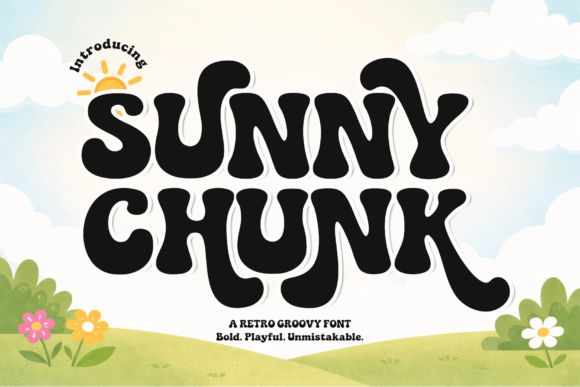
Selecting the right display typeface requires balancing aesthetic appeal with functional legibility. For designers and brand managers exploring vintage-inspired visuals, Sunny Chunk presents a distinct option within the retro revival category. This typeface is characterized by heavy, bulbous letterforms and exaggerated curves that evoke the psychedelic poster art of the 1970s. Unlike standard geometric sans-serifs or traditional serifs, Sunny Chunk utilizes a rhythmic, melting aesthetic to convey warmth and nostalgia. Understanding its specific visual mechanics helps determine whether it aligns with current project requirements or if an alternative style would better serve the communication goal.
Defining the Visual Mechanics of Sunny Chunk
Sunny Chunk distinguishes itself through extreme weight and organic fluidity. The letterforms are not merely bold; they are inflated, creating a sense of volume and softness rarely found in digital typography. This "melting" quality suggests movement and heat, making the font inherently associated with summer, leisure, and counter-culture history. When evaluating this typeface, it is important to recognize that it functions as a graphic element as much as a vehicle for text. The negative space between characters is often as significant as the strokes themselves, contributing to a dense, textured appearance on the page or screen.
This specific construction places Sunny Chunk firmly in the novelty display category. It lacks the neutrality required for interface design or long-form reading. Instead, it operates best at large scales where the intricacies of the curves remain visible. Designers should note that the font’s personality is dominant; it does not recede into the background. Any project utilizing Sunny Chunk must account for this high visual gravity, ensuring that supporting elements do not compete for attention but rather provide necessary contrast and breathing room.
Comparing Retro Styles: Psychedelic vs. Geometric vs. Script
When researching retro typography, professionals often encounter three primary sub-genres: psychedelic bubble styles like Sunny Chunk, mid-century geometric sans-serifs, and flowing hand-lettered scripts. Each serves a different strategic purpose. Mid-century geometrics offer a cleaner, more corporate interpretation of vintage design. They are legible at smaller sizes and pair easily with modern photography. If a brand requires a subtle nod to the past without overwhelming the layout, a geometric alternative may be superior.
Conversely, hand-lettered scripts emphasize human touch and imperfection. While they share the nostalgic quality of Sunny Chunk, scripts often struggle with scalability and reproduction across various media. Sunny Chunk offers a middle ground: it retains the organic, human-centric feel of hand-drawn art but maintains the structural consistency of a digital font file. This makes it more reliable for responsive web headers and merchandise printing than true script alternatives. However, compared to cleaner retro options, Sunny Chunk sacrifices versatility for impact. It is a specialized tool rather than a comprehensive system font.
Tradeoffs in Legibility and Application
The primary tradeoff when choosing Sunny Chunk is readability versus atmosphere. The heavy weight and tight spacing that create its signature look can reduce legibility at small point sizes or on low-resolution screens. In user experience testing, highly stylized display fonts often increase cognitive load if used improperly. Therefore, Sunny Chunk is rarely appropriate for navigation menus, body copy, or instructional text. Its utility is strictly limited to headlines, logos, and short phrases where immediate emotional resonance takes precedence over rapid information processing.
Furthermore, the font’s strong cultural association with the 1970s surf and music scenes creates a predefined narrative. This is beneficial for brands operating within those niches but potentially limiting for others. A tech startup or financial service attempting to use Sunny Chunk might send mixed signals unless the juxtaposition is intentional and carefully managed. In comparison, more neutral retro revivals allow for broader industry application without carrying such specific historical baggage.
Ideal Use Cases and Strategic Fit
Despite its limitations, Sunny Chunk excels in specific contexts where positive affect and sensory engagement are paramount. Evaluating its strengths reveals several high-fit scenarios:
- Independent Surf and Skate Branding: The font’s organic shapes mirror the fluid dynamics of water and the counter-cultural ethos of board sports. It authenticates brands seeking to distance themselves from polished, corporate athletic wear aesthetics.
- Summer Music Festivals and Events: Event marketing relies on generating excitement and anticipation. Sunny Chunk’s vibrant, sun-drenched soul translates effectively to posters, wristbands, and stage backdrops, signaling a relaxed yet energetic atmosphere.
- Organic Food and Beverage Packaging: For products like cold-pressed juice, craft soda, or natural snacks, the bulbous forms suggest freshness and abundance. The typeface communicates "natural" and "handmade" more effectively than sterile modern packaging fonts.
- Social Media Headers and Campaign Graphics: In crowded social feeds, high-contrast, heavy-weight typography stops the scroll. Sunny Chunk provides the necessary visual mass to anchor Instagram carousels or YouTube thumbnails without requiring complex illustration support.
In these applications, the font acts as a shorthand for a specific lifestyle. It reduces the need for explanatory copy by instantly establishing tone. However, success depends on restraint. Using Sunny Chunk for every touchpoint dilutes its impact. Effective campaigns typically reserve it for primary headlines while utilizing a complementary sans-serif for secondary information.
Technical Considerations and Pairing Strategies
Integrating Sunny Chunk into a design system requires careful technical planning. Because of its substantial x-height and wide stance, it consumes horizontal space rapidly. Designers must test line breaks extensively to avoid awkward hyphenation or excessive white space. In responsive environments, the font may require significant scaling adjustments between desktop and mobile viewports to maintain its intended proportion. What looks bold and impactful on a 27-inch monitor may appear bloated or illegible on a smartphone if not properly optimized.
Pairing is equally critical. The most successful combinations leverage contrast. Since Sunny Chunk is maximalist, its partner should be minimalist. A clean, monolinear sans-serif or a structured grotesque provides the necessary stability. Avoid pairing it with other decorative fonts, serifs with high contrast, or condensed typefaces, as these combinations create visual vibration and clutter. The goal is to let Sunny Chunk perform as the soloist while the supporting typeface acts as the rhythm section. Color selection also plays a role; warm palettes enhance its inherent vibe, while cool or neon palettes can push it toward a more futuristic or ironic interpretation.
Making the Final Selection Decision
Deciding whether to license or download Sunny Chunk involves assessing both creative alignment and practical constraints. Ask the following evaluation questions before committing:
- Does the brand voice match the font’s energy? If the brand is serious, luxury-focused, or data-driven, Sunny Chunk is likely a mismatch regardless of current trends.
- Will the font be used exclusively at large sizes? If there is any requirement for sub-headlines or captions in this style, reconsider the choice.
- Is the target audience receptive to overt nostalgia? While Gen Z and Millennials currently embrace Y2K and 70s aesthetics, saturation is increasing. Ensure the usage feels authentic rather than derivative.
- Are there accessibility concerns? Always test color contrast ratios with this specific typeface, as its thick strokes can sometimes bleed into backgrounds or reduce perceived contrast in certain combinations.
Sunny Chunk is a powerful asset for specific design challenges. It captures a nostalgic, sun-drenched soul that few other typefaces can replicate with such immediacy. However, it is not a universal solution. By understanding its distinct characteristics, comparing it against relevant alternatives, and respecting its functional boundaries, designers can leverage Sunny Chunk to create work that is both visually striking and strategically sound. The decision should ultimately rest on whether the font solves a specific communication problem or merely follows a trend. When used with intention, it transforms ordinary layouts into immersive experiences; when used without strategy, it risks becoming visual noise. Evaluate your project’s unique needs against these factors to determine if Sunny Chunk is the correct typographic investment.