Evaluating Stalker: A Practical Guide to Hand-Painted Display Typography
In the crowded landscape of display typography, finding a script font that balances artistic expression with functional legibility is a persistent challenge for designers and marketers. Stalker distinguishes itself as a bold, expressive typeface that moves beyond standard digital calligraphy to offer a genuinely hand-painted aesthetic. Rather than relying on algorithmic smoothing, this font family captures the fluid imperfections of physical brushwork, making it a relevant tool for projects requiring an organic, human touch. For creative professionals evaluating assets for street branding, editorial design, or apparel, understanding the specific utility of Stalker requires looking past its visual appeal to assess its technical versatility and practical application in commercial workflows.
Dual-Style Architecture and Textural Versatility
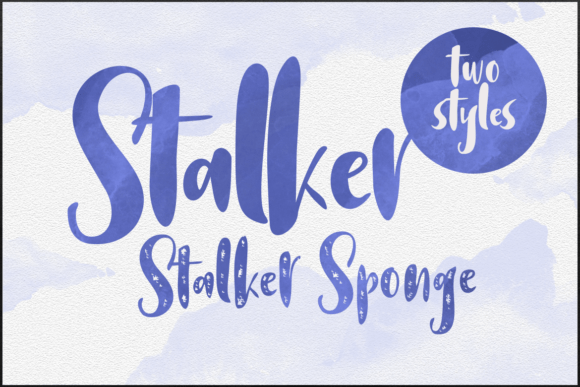
The primary value proposition of Stalker lies in its provision of two distinct styles within a single family: the standard Stalker and Stalker Sponge. This duality is not merely cosmetic; it addresses a common friction point in graphic design where a single typeface fails to adapt across different media or background treatments. The standard Stalker style offers solid, confident strokes with high contrast, suitable for clean layouts where the letterform itself must carry the visual weight. It retains the energy of wet paint without sacrificing the crisp edges necessary for smaller-scale reproduction or digital screens.
Conversely, Stalker Sponge introduces a distressed, textured finish that mimics ink absorption on porous surfaces like uncoated paper, cardboard, or fabric. In professional practice, this eliminates the need for post-production texturing. Designers often spend significant time applying grunge overlays or erosion filters to pristine fonts to achieve a raw look, a process that can degrade vector quality and increase file complexity. By baking this texture directly into the glyph outlines, Stalker Sponge provides a reliable, consistent distressed aesthetic that scales infinitely without pixelation. This makes it particularly effective for large-format printing where artificial textures often break down, as well as for merchandise design where screen printing benefits from pre-distressed artwork to reduce ink coverage issues.
Analyzing Form and Readability Constraints
Stalker is characterized by thick strokes and soaring ascenders, features that contribute significantly to its edgy, dynamic presence. From a composition standpoint, these vertical extremes create natural rhythm and interlocking opportunities between lines of text. However, they also impose specific spatial requirements. The generous cap height and ascender length demand ample leading (line spacing) to prevent visual collision. In tight horizontal spaces, such as mobile web headers or narrow packaging panels, the width of the bold strokes may necessitate tracking adjustments or copy editing to maintain legibility.
Despite its expressive nature, the underlying structure of Stalker remains grounded in readable script conventions. Unlike purely abstract graffiti styles that prioritize form over function, Stalker maintains clear character distinction. This balance is critical for commercial applications where brand recognition depends on instant readability. The hand-painted flow guides the eye horizontally, ensuring that even with its aggressive weight, the text functions as communication rather than mere decoration. Professionals should note, however, that this font is strictly a display face. It lacks the x-height consistency and open counters required for body copy, limiting its role exclusively to headlines, logos, and short-form statements.
Strategic Applications in Branding and Merchandise
The specific visual language of Stalker aligns with several high-demand niches in modern design. Its raw, unpolished energy makes it a natural fit for streetwear and urban fashion brands seeking authenticity. In apparel design, the Sponge variant performs exceptionally well on vintage-wash tees and heavy cotton hoodies, where the textured letterforms complement the garment's tactile quality. For entrepreneurs and small business owners in this sector, using a font that inherently suggests craftsmanship can elevate perceived product value without requiring custom hand-lettering commissions for every new release.
In the realm of event marketing and entertainment, Stalker serves as a potent tool for horror-themed posters, music festival lineups, and alternative culture publications. The typeface carries an inherent tension and urgency that supports dark or rebellious narratives. Yet, it avoids the cliché tropes of traditional horror fonts, offering a more contemporary, art-directed interpretation of fear and intensity. Editorial designers will find the standard style useful for magazine covers and feature headers where the goal is to arrest attention while maintaining enough sophistication to sit alongside high-quality photography. The font’s boldness allows it to hold its own against busy imagery, reducing the need for heavy drop shadows or stroke outlines that can clutter a layout.
Technical Considerations for Production Workflows
When integrating Stalker into professional pipelines, users should be mindful of licensing and file management. As with any specialized display font, verifying the license scope for commercial use, particularly for merchandise and embedding, is essential to avoid legal complications. Technically, the complex outlines of the Sponge variant can result in higher node counts compared to standard sans-serifs. While modern RIP software handles this effortlessly, designers working with older cutting plotters or embroidery digitization software may need to simplify paths to prevent machine errors or excessive stitch counts.
Color selection also plays a pivotal role in maximizing Stalker’s effectiveness. The bold strokes absorb color densely, meaning the font performs best in high-contrast scenarios. Light text on dark backgrounds tends to emphasize the outer edges and texture details, while dark text on light backgrounds emphasizes the overall mass and silhouette. When using the Sponge style, designers should test print proofs before finalizing production, as the perceived density of the distress pattern can vary significantly between RGB screens and CMYK output. What looks like subtle grain on a monitor may read as heavy speckling on press, potentially affecting legibility at smaller sizes.
Assessing Long-Term Value and Audience Fit
For freelancers and agencies building asset libraries, Stalker represents a high-utility investment due to its stylistic range. Fonts that offer both clean and textured variants effectively serve as two tools in one, streamlining the selection process for diverse client needs. Its distinctive hand-painted quality ensures it does not blend into the sea of generic brush scripts available through subscription services, providing a degree of exclusivity for brands that rely on unique visual identities. However, its strong personality means it is not a universal solution. Corporate finance, healthcare, or luxury sectors requiring understated elegance will likely find Stalker too aggressive or informal.
Ultimately, Stalker is best suited for creators who understand that typography is an active participant in storytelling, not just a vessel for words. It rewards thoughtful application and punishes lazy placement. Professionals who take the time to adjust spacing, pair it with complementary neutral typefaces, and respect its spatial demands will extract significant value. For those targeting audiences aged 20–50 who respond to authenticity and artisanal aesthetics, Stalker provides a credible, versatile typographic voice. It bridges the gap between digital precision and analog warmth, a combination that remains increasingly valuable in an era of AI-generated perfection. By offering a tangible sense of human creation, it helps brands connect on a visceral level, proving that even in digital design, the impression of a hand-held brush still carries profound communicative power.