Evaluating Banks: A Display Serif for Authoritative Branding
Selecting a typeface for high-stakes branding requires balancing aesthetic appeal with functional communication. For designers and brand strategists working within finance, architecture, or premium editorial sectors, the choice of typography often dictates the perceived value of the entity. Banks is an authoritative display serif designed specifically to address this need. It captures a stately and sophisticated soul through sturdy, high-contrast letterforms that merge historical credibility with contemporary sharpness. Understanding the specific characteristics, appropriate applications, and potential limitations of Banks is essential for determining whether it aligns with your project’s strategic goals.
Defining the Visual Character of Banks
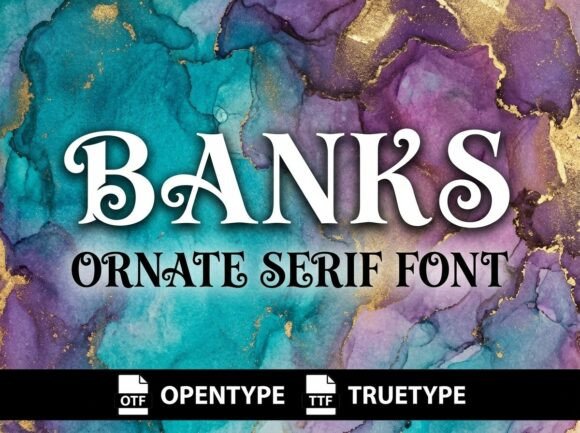
Banks distinguishes itself through a unique synthesis of vintage currency aesthetics and modern editorial sensibilities. While many serifs lean heavily into either traditional nostalgia or stark minimalism, Banks occupies a middle ground defined by structural weight and rhythmic detail. The typeface is characterized by high contrast between thick and thin strokes, providing the visual impact necessary for headlines and logos without sacrificing legibility at larger sizes.
The most distinct features of Banks are its swan-neck flourishes and spiraling spurs. These elements serve as more than mere decoration; they provide a rhythmic cadence that guides the eye across the wordmark or headline. This detailing bridges the gap between archival authenticity and current design trends. The result is a typeface that feels established and trustworthy, yet deliberately curated rather than antiquated. For evaluators, it is important to note that these flourishes are integrated into the letterform structure itself, ensuring they do not appear as afterthoughts but as foundational components of the font’s identity.
Strategic Applications and Ideal Use Cases
Banks is not a universal solution for all typographic needs. Its specific personality traits make it exceptionally strong in certain contexts while potentially problematic in others. Evaluating fit requires matching the font’s inherent authority with the brand’s market positioning.
Independent Finance and Fintech
In the financial sector, trust is the primary currency. Independent finance houses and boutique investment firms often struggle to convey the same level of institutional stability as legacy banks. Banks addresses this by leveraging visual cues associated with historical banknotes and bonds. The sturdy construction suggests permanence, while the refined details imply precision and attention to detail. For fintech companies seeking to differentiate themselves from generic sans-serif competitors, this typeface offers a way to signal maturity and sophistication.
Boutique Architecture and Real Estate
Architecture firms and luxury real estate developers require typography that mirrors the physical structures they represent. The sharp structural weight of Banks parallels architectural drafting and stone carving. It communicates solidity and intentional design. When used in signage, property brochures, or firm identities, it reinforces the concept of built environments that are both enduring and aesthetically considered.
Premium Editorial and Archival Content
For publications, journals, or digital platforms focused on history, economics, or luxury lifestyle, Banks serves as an effective tool for establishing tone. It works particularly well for mastheads, section headers, and pull quotes where the goal is to arrest attention and convey gravitas. The "authoritative-and-archival" quality makes it suitable for content that demands respect and careful reading, distinguishing it from the ephemeral nature of standard web typography.
Benefits and Value Proposition
When selected correctly, Banks offers several tangible benefits to a design system:
- Instant Credibility: The association with currency and classical engraving provides an immediate subconscious signal of value and legitimacy.
- Differentiation: In markets saturated with geometric sans-serifs and humanist serifs, the unique swan-neck flourishes create a memorable visual signature.
- Versatility in Display: Despite its ornate details, the high-contrast structure remains legible and impactful across various media, from business cards to large-format social media headers.
- Tonal Precision: It eliminates ambiguity regarding brand positioning, clearly signaling a premium or authoritative stance without requiring extensive supporting graphics.
Tradeoffs and Practical Considerations
An objective evaluation must also consider where Banks may fall short. Recognizing these tradeoffs prevents misapplication and ensures long-term satisfaction with the typeface selection.
Limited Utility for Body Text
Banks is strictly a display typeface. The high contrast and intricate flourishes that make it stunning at 48pt or above become liabilities at 12pt. Using this font for extended reading passages will result in poor legibility and reader fatigue. Projects requiring a cohesive type system must pair Banks with a highly readable text face, such as a neutral grotesque or a low-contrast serif, to handle body copy, captions, and UI elements.
Contextual Sensitivity
The prestigious personality of Banks can backfire if applied to brands that aim to be accessible, democratic, or playful. For a community credit union emphasizing approachability or a startup focusing on disruptive informality, this typeface may communicate exclusivity or elitism that alienates the target audience. Evaluators must ensure the font’s "stately soul" matches the brand’s actual customer relationship model.
Technical Rendering
The fine details and spiraling spurs require adequate resolution to render correctly. On low-resolution screens or when printed on uncoated paper with significant ink spread, the delicate thins may break up or fill in. Testing in the final output environment is mandatory. Designers may need to adjust tracking or avoid using the smallest recommended display sizes in certain production contexts.
Comparing Alternatives
Before committing to Banks, it is prudent to compare it against adjacent options to validate the decision.
- Versus Traditional Didones (e.g., Bodoni, Didot): Traditional Didones offer similar high contrast but lack the specific swan-neck flourishes and currency-inspired spurs. Choose Banks if you need a more bespoke, less fashion-oriented feel. Stick to traditional Didones if the goal is pure elegance or luxury retail.
- Versus Engraved/Ornamental Faces: Purely ornamental fonts often sacrifice readability for decoration. Banks maintains a stronger structural skeleton, making it more functional for logos and headlines. Choose alternatives only if the project is purely illustrative and does not require linguistic clarity.
- Versus Modern Slab Serifs: Slab serifs convey authority through mass rather than contrast. If the brand needs to feel industrial or robust rather than sophisticated and financial, a slab serif may be a better fit. Banks is preferable when the desired impression is refinement over raw strength.
Making the Final Decision
Determining whether Banks is the right choice involves a checklist of alignment factors. First, confirm that the primary application is display-level branding or headlines. Second, verify that the brand attributes include authority, sophistication, and heritage. Third, assess the technical requirements of the primary touchpoints to ensure the fine details will survive reproduction. Finally, test the pairing with a candidate body text font to ensure the overall system functions harmoniously.
Banks represents a specialized tool in the typographic arsenal. It is not designed to be invisible; it is designed to command the room. For organizations where perception of stability and prestige is directly tied to commercial success, this typeface offers a structured, aesthetically distinct solution. However, for projects prioritizing neutrality or high-volume readability, other categories remain superior. By weighing these factors objectively, designers and stakeholders can select Banks with confidence, knowing its capabilities and constraints align with their specific strategic objectives.