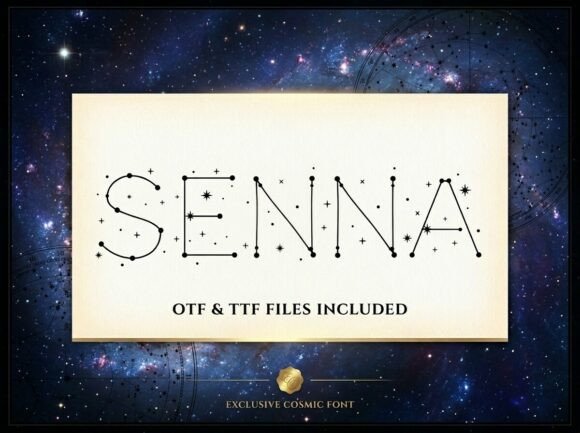
Evaluating Senna: A Celestial Display Typeface for Spiritual Branding
Selecting the right typography is a critical step in establishing visual identity, particularly within niche markets where aesthetic cues carry significant semantic weight. For designers and brand strategists working within astrology, tarot, modern spirituality, or cosmic-themed projects, Senna presents a specialized solution. Marketed with the tagline "Map out the stars with Senna," this display typeface offers a distinct visual language that merges geometric minimalism with astronomical symbolism. However, like any highly stylized font, it requires careful evaluation to determine if its specific characteristics align with project goals. This analysis explores the functional attributes, appropriate use cases, and practical limitations of Senna to assist in informed decision-making.
Defining the Visual Architecture of Senna
Senna is categorized as a display typeface, meaning it is engineered primarily for headlines, logos, and short-form text rather than extended reading. Its design philosophy centers on mimicking the visual structure of astronomical constellations. Unlike traditional serif or sans-serif fonts that rely on stroke contrast or uniform stems, Senna constructs letterforms using solid nodes connected by fine lines. This creates a network-like appearance reminiscent of star charts.
The typeface incorporates a rhythmic scattering of delicate star points and crosses throughout the character set. These elements are not merely decorative overlays but are integrated into the geometric construction of the glyphs. The result is an airy, open composition that conveys a sense of infinite space and mysticism without resorting to ornate or heavy-handed illustration. For evaluators, understanding this structural basis is essential; Senna is not a standard text font with added effects, but a purpose-built graphic system where the negative space is as active as the positive forms.
Strategic Fit: When Senna Aligns with Brand Goals
The decision to adopt Senna should be driven by specific branding objectives. It is most effective when the project requires immediate visual communication of celestial or ethereal themes. Several scenarios highlight where this typeface serves as a strong functional asset:
- Independent Astrology Branding: For practitioners building personal brands, Senna provides instant category recognition. The constellation-style letterforms signal astrological content before the viewer reads a single word, reducing cognitive load in social media feeds.
- Tarot and Oracle Card Design: Deck design requires typography that complements illustrative art without competing with it. Senna’s fine lines and airy geometry allow it to sit harmoniously alongside intricate linework or watercolor textures common in modern deck aesthetics.
- Cosmos-Themed Social Media Headers: Digital banners often suffer from visual clutter. Senna’s minimalist approach ensures legibility at smaller screen sizes while maintaining the thematic atmosphere necessary for stargazer communities.
- Modern Spiritual Logos: As spiritual branding moves away from traditional religious iconography toward more abstract, universal symbols, Senna offers a contemporary alternative that feels both ancient and futuristic.
In these contexts, Senna functions as a shorthand for "celestial" and "mystical," allowing designers to establish tone efficiently.
Tradeoffs and Functional Considerations
While Senna excels in atmospheric display work, its specialized nature introduces specific tradeoffs that must be weighed during the selection process. Evaluators should consider the following constraints to avoid usability issues downstream.
Legibility and Hierarchy
The very features that make Senna visually striking also limit its versatility. The fine connecting lines and scattered star points can degrade at small sizes or on low-resolution screens. This typeface is strictly for display purposes. It should never be used for body copy, captions, or interface text. Projects utilizing Senna will require a secondary, highly legible typeface (such as a clean geometric sans-serif or a neutral humanist serif) to handle informational content. If a project lacks the budget or space for a robust typographic pairing system, Senna may create hierarchy problems.
Visual Density and Background Interaction
Senna’s airy construction makes it sensitive to background complexity. Because the letterforms rely on thin lines and negative space, placing them over busy photographic backgrounds or high-contrast patterns can cause the text to vibrate or disappear. Evaluators must assess the intended application environment. Senna performs best against solid colors, subtle gradients, or deep space imagery where the contrast is controlled. If the primary use case involves overlaying text on unpredictable user-generated content or complex video, additional treatments like backing plates or drop shadows may be necessary, which could alter the font's intended delicate aesthetic.
Tone Specificity
Senna carries a strong personality. It reads as mystical, feminine, soft, and ethereal. It does not convey corporate authority, technological precision, or rugged durability. If a brand operates in the wellness space but wishes to project clinical credibility or scientific rigor, Senna may send conflicting signals. It is crucial to audit the brand’s core values against the font’s inherent mood. A mismatch here can undermine trust, even if the visual execution is technically proficient.
Comparing Alternatives and Decision Framework
Before finalizing Senna as the primary display face, it is prudent to compare it against adjacent options to ensure it is the optimal choice. The market offers various celestial-inspired typefaces, each with different strengths.
If the project requires a celestial theme but demands higher legibility or a more structured feel, a standard geometric sans-serif with custom ligatures or alternate characters might offer a safer middle ground. Conversely, if the goal is historical authenticity in tarot or occult design, a blackletter or woodblock revival font may be more appropriate than Senna’s modern minimalism. Senna occupies a specific intersection of modern and mystical; it is less suitable for projects leaning heavily into vintage, grunge, or hyper-corporate aesthetics.
When evaluating whether Senna is the correct investment, apply the following decision matrix:
- Audience Alignment: Does the target demographic associate constellation aesthetics with quality and relevance? For Gen Z and Millennial spiritual seekers, the answer is typically yes. For older, traditionalist demographics, the abstraction may be less effective.
- Application Scale: Will the font primarily appear at large sizes (posters, web headers, packaging)? If the majority of touchpoints are small-scale (business cards, mobile UI), Senna’s utility diminishes significantly.
- Pairing Viability: Do you have a complementary body font selected? Senna cannot stand alone. Successful implementation depends entirely on the strength of the supporting typographic system.
- Longevity vs. Trend: Celestial minimalism is currently prominent in design trends. Consider whether the brand needs a timeless foundation or a timely refresh. Senna is excellent for capturing current cultural momentum but may require updating as design cycles shift.
Final Assessment for Design Professionals
Senna is a specialized tool designed for a specific set of creative challenges. It successfully translates the abstract concepts of infinity and celestial mapping into a usable typographic form, making it a premier candidate for independent astrology branding, tarot design, and modern spiritual identities. Its minimalist letterforms and rhythmic star points offer a sophisticated alternative to cliché mystical typography.
However, its effectiveness is contingent upon proper application. It demands high-contrast environments, large-scale usage, and thoughtful pairing with neutral body text. For designers and brand managers who understand these parameters, Senna provides a unique opportunity to create cohesive, atmospheric visual identities that resonate deeply with niche audiences. For those requiring broader versatility or higher density information delivery, alternative solutions should be explored. Ultimately, the value of Senna lies not in its novelty, but in its ability to solve specific communication problems within the celestial and spiritual design sector with elegance and intentionality.