Saro Food: A Practical Evaluation of Bold Display Typography for Culinary Branding
In the competitive landscape of food and beverage marketing, typography serves as more than just a vessel for information; it acts as a primary sensory cue. Saro Food enters this space as a specialized all-caps display font designed specifically to evoke appetite and energy. Unlike versatile sans-serifs intended for body copy or corporate neutrality, Saro Food is a niche tool crafted to make designs pop with flavor. Its defining characteristics—strong rounded shapes and a dynamic extrude style—position it as a high-impact asset for posters, packaging, coffeeshop branding, burger and pizza labels, cafe menus, and restaurant promotions. For designers and business owners evaluating typefaces for culinary projects, understanding the functional strengths and limitations of Saro Food is essential for effective brand communication.
Visual Mechanics and Design Characteristics
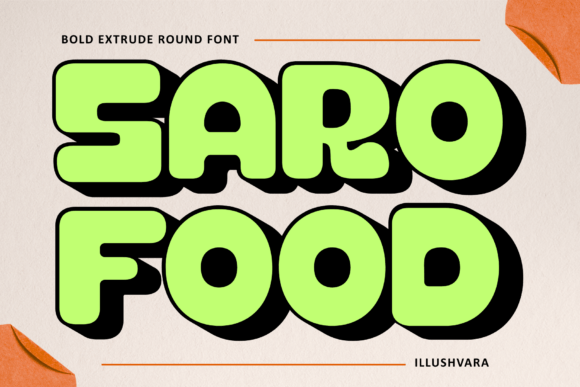
The effectiveness of a display font lies in its ability to communicate tone instantly. Saro Food utilizes a bold, all-caps structure that eliminates the visual noise of lowercase variation, creating a uniform block of text that commands attention. The "strong rounded shapes" are not merely aesthetic choices; in color psychology and food design, rounded forms are frequently associated with softness, sweetness, and organic ingredients. Sharp angles can sometimes signal danger or artificiality, whereas the curvature in Saro Food aligns naturally with the tactile expectations of baked goods, fresh produce, and comfort food.
The most distinct feature of this typeface is its dynamic extrude style. This built-in dimensional effect creates an immediate sense of depth without requiring additional graphic design work. In practical application, this means the font carries its own shadow or highlight layer, simulating a 3D appearance. This reduces the production time for creating promotional materials, as the designer does not need to manually construct drop shadows or bevels to achieve a lively look. The extrusion adds weight and presence, making the text feel tangible, which is particularly valuable when designing for physical media like packaging or window decals where readability at a distance is paramount.
Practical Applications in Food Marketing
Saro Food is engineered for specific use cases rather than general utility. Evaluating its performance requires looking at where it succeeds in real-world scenarios:
- Packaging and Labels: On burger wrappers, pizza boxes, or snack bags, legibility at small scales and shelf impact are critical. The bold weight of Saro Food ensures that product names remain readable even when printed on textured paper or viewed through plastic wrapping. The dimensional style helps the text separate from busy background patterns common in food packaging.
- Coffeeshop and Cafe Menus: Menu boards often suffer from visual clutter. Using Saro Food for category headers (e.g., "ESPRESSO," "PASTRIES") creates clear visual hierarchy. The playful yet sturdy aesthetic supports the artisanal vibe common in modern coffee culture without appearing too childish or informal.
- Restaurant Promotions and Posters: For limited-time offers or seasonal specials, the font’s energetic vibe drives urgency. The all-caps format allows for tight tracking and large point sizes, maximizing the use of poster real estate to convey short, punchy messages like "FRESH DAILY" or "HOT NOW."
- Digital Social Media Assets: On platforms like Instagram or TikTok, where users scroll rapidly, Saro Food provides the necessary contrast to stop the scroll. The extruded details remain visible even on mobile screens, ensuring the brand message is not lost in compression.
Evaluating Usability and Workflow Integration
From a production standpoint, Saro Food offers significant efficiency benefits. The integrated extrude style is a double-edged sword that leans heavily toward benefit for fast-paced environments. For freelancers and small business owners managing their own marketing, having a font that looks "finished" out of the box reduces reliance on complex layer effects in software like Photoshop or Illustrator. This consistency ensures that the brand identity remains stable across different mediums, whether designed by a senior art director or a junior staff member using Canva.
However, usability also involves understanding spacing and pairing. Because Saro Food is an all-caps display face with inherent depth, it demands generous negative space around it. Crowding this typeface against other elements diminishes its impact and can reduce legibility. It performs best when treated as a standalone graphical element rather than part of a dense text block. Designers should plan layouts that allow the font to breathe, utilizing solid colors or simple gradients behind it to let the extrusion details stand out clearly.
Audience Fit and Strategic Value
Not every food-related project requires Saro Food. Its value is highest for brands targeting an audience that responds to bold, expressive, and approachable aesthetics. This includes fast-casual dining, street food vendors, craft breweries, dessert shops, and family-oriented restaurants. These sectors benefit from typography that feels loud, bright, and delicious.
Conversely, the font may be less suitable for fine dining establishments, luxury wine brands, or health-focused clinical nutrition services. In those contexts, the playful roundness and heavy extrusion might undermine perceptions of elegance, sophistication, or scientific precision. Professionals must evaluate whether the "tasty, energetic vibe" aligns with their specific brand positioning before adoption.
For marketers and entrepreneurs, the strategic value of Saro Food lies in its ability to differentiate. In a market saturated with minimalist, thin-line typography, a return to bold, dimensional lettering signals confidence and fun. It acts as a visual shorthand for flavor intensity and satisfaction. When used consistently across touchpoints—from the storefront sign to the takeout bag—it builds a cohesive visual language that reinforces brand recall.
Technical Considerations and Limitations
While Saro Food excels in display settings, users must recognize its boundaries to maintain professional quality:
- No Body Copy Utility: This is strictly a headline font. Attempting to use Saro Food for descriptions, ingredients lists, or legal disclaimers will result in poor readability and visual fatigue. It must be paired with a clean, neutral sans-serif or serif for supporting text.
- All-Caps Constraint: The lack of lowercase letters limits typographic nuance. Acronyms and proper nouns will all share the same height, which can sometimes create ambiguous readings. Careful proofreading and layout adjustment are necessary to ensure clarity.
- Color Dependency: The extrude style relies on color contrast to be effective. Printing this font in single-color black on white paper may flatten the design, negating its primary advantage. Users should plan for two-color printing or digital displays to fully leverage the dimensional aspects.
- Trend Awareness: Dimensional, bubbly typography currently enjoys popularity in retro and Y2K revival trends. While Saro Food is well-executed, relying solely on trend-based aesthetics carries a risk of dating the brand. It is advisable to anchor the font within a broader, timeless brand system to ensure long-term viability.
Making the Decision for Your Project
Ultimately, Saro Food is a specialized instrument in the typographic toolkit. It solves a specific problem: how to make food-related text visually appetizing and energetically engaging without extensive custom illustration. For professionals, creators, and business owners in the culinary space, it offers a reliable shortcut to achieving a polished, high-energy look.
When considering this typeface, assess your current brand assets. If your existing typography feels sterile, quiet, or disconnected from the sensory experience of your food, Saro Food provides a viable corrective. It brings a tasty, energetic vibe that translates directly to consumer perception. However, if your brand relies on subtlety, luxury, or extensive textual communication, this font should likely remain in reserve for specific campaign accents rather than serving as a primary identity marker.
Evaluating typefaces is an exercise in matching form to function. Saro Food succeeds because it does not pretend to be a universal solution. It commits fully to being bold, rounded, and dimensional, delivering exactly what it promises for posters, packaging, and promotions. By understanding its specific strengths and respecting its limitations, designers can utilize Saro Food to make brands louder, brighter, and more visually delicious, ensuring that the typography works as hard as the kitchen to attract and satisfy customers.