Martian Child: Launch Your Designs Into Another Dimension
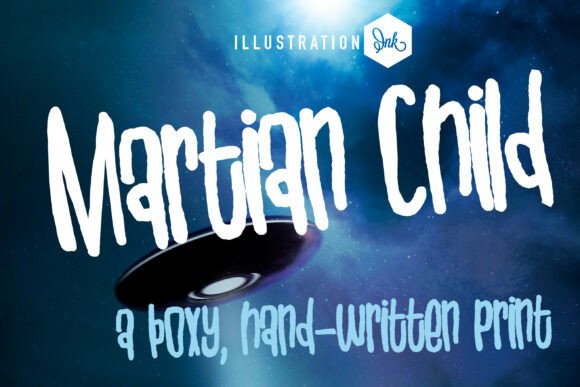
Finding a typeface that balances genuine whimsy with professional readability is often a frustrating exercise for designers and creators. You usually have to choose between sterile, geometric sans-serifs that lack personality or novelty fonts that are too messy to be functional. Martian Child occupies the rare middle ground where these two worlds collide. It is a quirky display typeface that captures an otherworldly-and-playful soul without sacrificing structural integrity. The font features tall, narrow letterforms with a rhythmic, boxy structure, yet it retains authentic hand-drawn irregularities that make it feel both alien and approachable.
This isn't just another sci-fi font; it is a design tool built for specific emotional outcomes. Its high-contrast vertical energy and raw space-sketch personality make it the premier choice for projects that need to signal creativity, futurism, and fun simultaneously. Whether you are an independent author finalizing a book cover, a brand manager designing extraterrestrial-themed apparel, or a social media strategist looking for scroll-stopping headers, understanding how to leverage this typeface can elevate your visual communication from generic to memorable.
Defining the Aesthetic: Boxy Rhythm Meets Hand-Drawn Soul
To use Martian Child effectively, you first need to understand what makes it tick visually. Unlike standard monospaced fonts that feel robotic, or organic hand-lettering that feels chaotic, this typeface offers a controlled irregularity. The vertical stress draws the eye upward, creating a sense of height and aspiration that mimics the concept of space travel itself. However, the edges aren't perfectly vector-smooth. They carry the subtle imperfections of a marker sketch on graph paper.
This duality is its greatest asset in practical application. When you set text in Martian Child, you aren't just communicating words; you are communicating a texture. It suggests that a human being was involved in the creation process, even if the subject matter is non-human. For designers working on digital interfaces or print materials, this means the font pairs exceptionally well with clean, minimalist body copy. Let Martian Child handle the heavy lifting in headlines and titles, while a neutral sans-serif handles the dense reading. This contrast ensures your design remains accessible while retaining its distinct character.
Independent Publishing and Children’s Book Titles
The self-publishing market is saturated, and cover design is often the primary differentiator between a book that gets clicked and one that gets ignored. For authors in the children’s sci-fi, middle-grade fantasy, or graphic novel genres, Martian Child solves a specific branding problem. Standard "space" fonts often lean too hard into military aesthetics or retro 80s nostalgia. If your story is about friendship, curiosity, or gentle exploration rather than galactic warfare, those aggressive fonts send the wrong signal.
Martian Child signals "adventure" without signaling "danger." Its narrow width is particularly practical for book spines and title treatments where horizontal space is at a premium but vertical impact is necessary. Consider a scenario where you are designing a series of chapter books. Using this typeface for the series title creates immediate shelf recognition. The hand-drawn quality appeals to parents and educators looking for content that feels artisanal and thoughtful, distinguishing your work from mass-market, AI-generated covers. It tells the buyer that this book has heart.
Extraterrestrial-Themed Apparel and Merchandise
For entrepreneurs running print-on-demand businesses or boutique clothing lines, typography is the product. In the niche of space-themed streetwear and kids' apparel, legibility at a distance is crucial. The high-contrast vertical energy of Martian Child ensures that slogans and brand names remain readable even when printed on textured fabrics like heathered cotton or fleece.
Beyond simple readability, the font’s boxy structure lends itself to modular layout designs. You can stack words vertically or create tight, justified blocks of text that mimic mission patches or retro-futuristic control panels. This works beautifully for t-shirt graphics, tote bags, and enamel pins. Because the letterforms have inherent personality, you often don't need complex illustrations to support them. A simple phrase set in Martian Child can stand alone as a complete graphic element, reducing production complexity and ink costs while maintaining high visual value. For small business owners, this efficiency translates directly to better margins and faster turnaround times.
Creative Toy Packaging and Educational Materials
Packaging design requires a delicate balance of excitement and information hierarchy. For creative toys, STEM kits, and educational games, Martian Child serves as an excellent anchor for the product name. The font’s playful irregularities suggest that the toy inside is imaginative and open-ended, rather than rigid or purely academic. It bridges the gap between "fun" and "smart," which is exactly the demographic sweet spot for modern educational products.
Educators and homeschool resource creators can also benefit from this aesthetic. When designing worksheets, classroom posters, or presentation slides about astronomy or space history, using a font that feels handcrafted can increase student engagement. It removes the sterility often associated with science education. The approachable nature of the letterforms makes complex topics feel less intimidating to younger learners. Just ensure you reserve it for titles and callouts; the intricate details of the hand-drawn strokes will get lost if used for long paragraphs of instructional text.
Digital Impact: Social Media Headers and Web Typography
In the fast-paced environment of social media, you have milliseconds to capture attention. Martian Child’s unique silhouette performs exceptionally well in thumbnails, Instagram carousels, and YouTube headers. The tall aspect ratio allows for large, bold text that fits within vertical video formats or square posts without dominating the entire frame. This leaves ample negative space for imagery, which is essential for maintaining visual balance in digital layouts.
For web designers, this typeface works best as a display font for hero sections or feature highlights. It adds a layer of bespoke craftsmanship to websites that might otherwise rely on system fonts. However, performance matters. Because of its detailed contours, ensure you are serving optimized web font files to prevent slow load times. Use it strategically to guide user attention to key conversion points or narrative elements, reinforcing the site's theme without compromising usability.
Practical Considerations Before Implementation
While Martian Child is versatile, it is not a universal solution. Before downloading or purchasing, consider the following practical constraints to ensure it serves your project effectively:
- Hierarchy is Key: This is strictly a display typeface. Do not attempt to use it for body copy, captions, or fine print. The irregularities that give it charm at large sizes become visual noise at small sizes.
- Color Contrast: Due to the varying stroke widths and hand-drawn edges, this font requires strong contrast against its background. Avoid placing it over busy photographic backgrounds without a solid overlay or drop shadow, as the organic edges can blend into image noise.
- Pairing Strategy: Pair it with simple, stable typefaces. A geometric sans-serif or a clean slab serif provides the necessary grounding. Avoid pairing it with other decorative or distressed fonts, as the competing textures will create visual chaos.
- Licensing Compliance: Always verify the specific license terms for your intended use. Commercial projects like apparel, book covers, and paid advertising typically require a different license tier than personal or editorial use. Respecting intellectual property protects your business from future legal complications.
- Audience Alignment: While the font is playful, assess whether your specific audience responds to whimsy. For corporate B2B aerospace communications, this may be too informal. For consumer-facing brands targeting millennials and Gen Z, it hits the right note of nostalgic futurism.
Martian Child offers a distinct opportunity to inject personality into projects that often suffer from cliché aesthetics. By focusing on its strengths—vertical rhythm, hand-drawn warmth, and structural clarity—you can create designs that feel authentically crafted. Whether you are launching a new product line, publishing a story, or refreshing a digital presence, this typeface provides the visual vocabulary to say something truly out of this world.