Evaluating Easton: When Romantic Serif Typography Fits Your Design Strategy
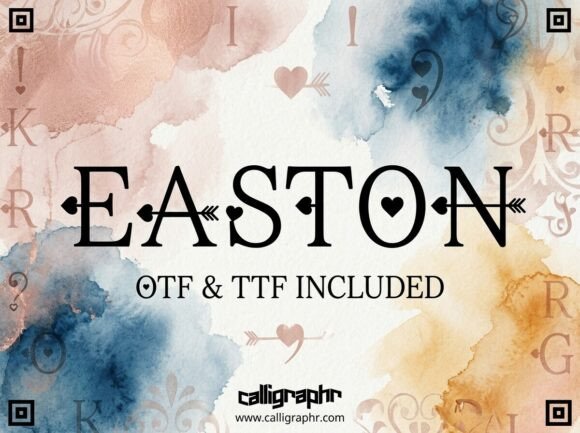
Selecting the right typeface for emotional branding requires balancing aesthetic appeal with functional legibility. Easton occupies a specific niche in this spectrum as a display serif that integrates hand-drawn motifs directly into traditional letterforms. Unlike standard fonts where decorative elements are added as separate graphic overlays, Easton features cupid’s arrows and heart motifs that pierce through the stems of the characters themselves. This structural integration creates a unified visual texture that differs significantly from pairing a plain serif with external clip art. For designers and brand managers evaluating options for Valentine’s Day campaigns, wedding stationery, or boutique jewelry identities, understanding the specific tradeoffs of this integrated approach is essential for making an informed selection.
Distinguishing Integrated Motifs from Decorative Pairings
The primary differentiator of Easton is how it handles ornamentation. In many design workflows, achieving a romantic aesthetic involves selecting a high-contrast serif and manually placing vector hearts or arrows around the text. While this offers maximum flexibility, it often results in a disjointed composition where the decoration feels superficial rather than intrinsic. Easton solves this coherence issue by embedding the narrative element into the glyph structure. The arrows and hearts follow the rhythm of the baseline and x-height, ensuring that the decorative aspects respect the typographic grid.
However, this integration introduces distinct constraints compared to modular design approaches:
- Fixed Narrative: You cannot easily remove the arrows or hearts without altering the font file or using OpenType alternates if provided. If a project requires a neutral version of the same letterform for secondary information, Easton may not suffice on its own.
- Spacing Dependencies: Because the motifs extend beyond standard bounding boxes, kerning and tracking require careful attention. Tight spacing that works for a standard serif may cause overlapping arrows in Easton, necessitating wider tracking or manual optical adjustments.
- Visual Weight Distribution: The pierced stems alter the perceived weight of the characters. Designers accustomed to uniform stroke widths must account for areas where the motif removes negative space or adds positive mass, which can affect overall color balance in a block of text.
Best-Fit Scenarios for Display Application
Easton is engineered specifically for display purposes, meaning its optimal performance range is limited to larger point sizes. Evaluating whether your project falls within this operational window is the first step in determining fit. The intricate details of the hand-drawn elements degrade rapidly below 24pt in print or equivalent pixel density on screens. Consequently, this typeface excels in environments where the text serves as a primary visual anchor rather than a vehicle for dense information.
Wedding Stationery and Formal Invitations
In the context of wedding design, Easton offers a sophisticated alternative to script fonts. While scripts convey intimacy through fluid connectivity, they can sometimes lack the authoritative structure required for formal logistics. Easton provides the romance of a gesture-based motif with the readability of a serif skeleton. It is particularly effective for names, dates, and venue headers where clarity is paramount but tone must remain affectionate. Compared to engraving-style serifs, Easton feels more contemporary and personal; compared to calligraphy, it offers superior legibility at a glance.
Boutique Jewelry and Luxury Branding
Jewelry brands often struggle to communicate "love" without resorting to clichés. Easton’s sharp serifs and balanced structural weight align well with luxury aesthetics, while the subtle heart motifs provide thematic relevance without overt sentimentality. When evaluating this font for logos or packaging, consider the reproduction method. The fine lines of the pierced stems require high-resolution printing or precise digital rendering. For embossing or foil stamping, verify that the motif details are robust enough to hold ink or impression depth; extremely thin connections in the arrow shafts may be lost in certain physical production processes.
Seasonal Social Media Headers
For Valentine’s Day campaigns, speed and impact are often prioritized. Easton reduces production time by eliminating the need to source and position separate illustrative elements. The font acts as both typography and illustration simultaneously. However, social media platforms impose strict safe zones and varying aspect ratios. Because Easton’s decorative elements extend vertically and horizontally, designers must test header compositions across devices to ensure critical motifs are not cropped. In these high-impact, low-dwell-time environments, the immediate recognition of the heart-arrow fusion communicates theme faster than a viewer could parse a complex illustrated layout.
Tradeoffs and Limitations to Consider
No typeface is universally applicable, and Easton’s specialized nature amplifies both its strengths and weaknesses. A thorough evaluation must acknowledge where this tool fails to meet project requirements.
Limited Versatility Across Hierarchy: A complete design system typically requires multiple weights and styles. As a display face with unique ornamentation, Easton cannot serve as a body copy font or even a subhead in most layouts. You will inevitably need to pair it with a complementary neutral serif or sans-serif. The success of Easton depends heavily on this pairing; choose a partner typeface that shares similar proportions or x-height characteristics to maintain visual harmony without competing for attention.
Tone Specificity: The romantic-and-sharp soul of Easton is unmistakable. This makes it risky for brands that need to pivot between emotional and corporate messaging. If your brand voice is primarily clinical, technical, or minimalist, introducing Easton for a seasonal campaign may create tonal dissonance that confuses audience perception. It is best suited for brands where affection is already a core pillar of identity.
Reproduction Sensitivity: The delicate nature of hand-drawn motifs means Easton is less forgiving than geometric serifs. Low-quality paper stock, poor screen calibration, or aggressive compression can obscure the very details that define the font. Before committing to Easton for a large print run or responsive web implementation, conduct physical or cross-device proofs to ensure the pierced stems remain distinct and do not fill in or break apart.
Decision Framework: Choosing Between Easton and Alternatives
When comparing Easton against other romantic display options, use the following criteria to guide your decision:
- Evaluate Legibility Requirements: If the text contains complex words, long phrases, or critical logistical data, prioritize readability over ornamentation. Easton works best for short strings (2–5 words). For longer headlines, consider a standard high-contrast serif and reserve Easton for single-word accents or monograms.
- Assess Production Constraints: If your output includes small-scale applications like business cards, tags, or mobile UI elements, Easton’s details may be lost. Reserve it for large-format or hero-position digital assets. For smaller touchpoints, opt for a simpler romantic serif or a solid symbol.
- Consider Brand Longevity: Is this a permanent rebrand or a temporary campaign? Easton’s strong thematic association makes it ideal for seasonal work or businesses permanently rooted in romance (weddings, jewelry). For general lifestyle brands, using it year-round may dilute its specialness or feel out of place during non-romantic seasons.
- Analyze Visual Competition: Review your competitive landscape. If competitors rely heavily on script fonts, Easton’s structured serif form offers differentiation while maintaining category relevance. If competitors use similar ornamental serifs, evaluate whether Easton’s specific arrow-heart motif feels fresh or derivative in context.
Practical Implementation Guidelines
To maximize Easton’s effectiveness while mitigating its limitations, adhere to these practical application principles. Always set Easton with generous tracking; the integrated motifs need breathing room to read clearly. Avoid all-caps settings unless testing confirms that capital-to-capital motif interactions remain legible and aesthetically pleasing—often, title case or lowercase yields better rhythmic flow due to the ascender/descender interplay.
When pairing, select supporting typefaces that defer to Easton’s personality. A clean, low-contrast sans-serif or a traditional old-style serif typically works better than another decorative face. Ensure sufficient contrast in weight and style so the hierarchy remains instantly scannable. Finally, treat Easton as a premium ingredient: use it sparingly for maximum impact. Overuse diminishes both legibility and emotional resonance. By respecting its specialized nature and applying it within its optimal parameters, Easton delivers a distinctive blend of tradition and affection that few generic alternatives can replicate.