Claud: Mastering Raw, Distressed Typography in Visual Design
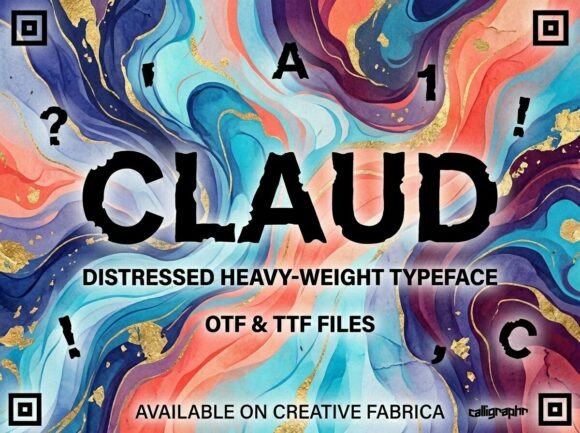
In the vast ecosystem of digital typography, clarity and legibility often reign supreme. Designers are frequently taught to prioritize clean lines, balanced kerning, and polished aesthetics to ensure seamless communication. However, there exists a distinct category of visual storytelling where perfection is the enemy of emotion. When a project demands a sense of history, trauma, intensity, or unrefined power, pristine sans-serifs fail to capture the necessary atmosphere. This is where Claud enters the design conversation. As a distressed heavy-weight typeface, Claud is not merely a font; it is a textural element that brings a raw, visceral energy to creative work.
Understanding how and when to deploy such an aggressive display font requires moving beyond basic aesthetic preference. It involves recognizing the psychological weight of jagged edges and weathered surfaces. For creators, business owners, and designers looking to make a bold statement, mastering the application of Claud can transform a standard layout into an immersive experience. This guide explores the practical realities of working with this monumental typeface, ensuring your design choices serve both the artistic vision and the end user.
The Anatomy of Gritty Intensity
To use Claud effectively, one must first understand what distinguishes it from standard bold fonts. Most heavy-weight typefaces achieve impact through sheer mass and geometric precision. Claud achieves impact through imperfection. Its letterforms are massive and blocky, providing the necessary footprint for headlines, but the silhouette is defined by irregularity.
- Jagged, Bitten Edges: Unlike the smooth curves of traditional display fonts, Claud features eroded contours that suggest physical damage or decay. This mimics real-world wear, making digital text feel tangible and aged.
- Weathered Texture: The internal texture of the glyphs is not solid ink. It contains noise and variation that evokes a sense of rugged survival. This prevents the "digital flatness" that often plagues modern graphic design.
- Monumental Weight: Despite the distress, the underlying structure remains incredibly heavy. This ensures that even with the textured erosion, the font maintains high contrast against backgrounds and remains readable at large sizes.
- Artisanal Chaos: No two letters feel manufactured on the same assembly line. The inconsistency creates a handcrafted, almost anarchic rhythm that static fonts cannot replicate.
These characteristics mean that Claud functions as much like a grunge brush or a photographic overlay as it does a typographic tool. When selecting this typeface, you are choosing to introduce controlled chaos into your composition.
Strategic Applications: Where Claud Thrives
Because of its intense personality, Claud is not a universal solution. It is a specialized instrument best suited for environments where the goal is to provoke a strong emotional response or establish a specific subcultural identity. Evaluating whether this font fits your project depends entirely on the narrative you are trying to convey.
Horror and Thriller Media
The most immediate association with distressed typography is the horror genre. Whether designing a movie poster for a zombie-apocalypse thriller, a book cover for a slasher novel, or title cards for a suspense game, Claud delivers instant atmospheric context. The bitten edges subconsciously signal danger, violence, or neglect to the viewer before they even process the words. In this context, the font acts as a visual shorthand for the genre's themes, reducing the cognitive load required to set the mood.
Urban Streetwear and Alternative Fashion
Fashion branding, particularly within streetwear and skate culture, often rejects corporate polish in favor of authenticity and rebellion. Claud aligns perfectly with this ethos. Its aggressive posture works exceptionally well for logo lockups, t-shirt graphics, and limited-edition drop announcements. The font communicates a sense of being "lived-in" and anti-establishment, which resonates deeply with demographics that value grit over gloss. When used on apparel, the texture of Claud mimics the natural fading and distressing of fabric, creating a cohesive product experience.
High-Impact Gaming and Esports
In the gaming industry, visual identity must be instantly recognizable in crowded marketplaces. For titles involving post-apocalyptic settings, industrial warfare, or survival mechanics, Claud provides the necessary visual volume. It stands up well against busy background art and complex UI elements. Furthermore, its sharp, irregular silhouette creates dynamic negative space that can be integrated with other graphical assets, such as scratches, blood splatters, or industrial textures, without looking out of place.
Aggressive Event Promotion
Concert posters for metal, punk, or hardcore genres, as well as promotional materials for extreme sports events, require typography that matches the auditory or physical intensity of the subject matter. A clean Helvetica header would feel dissonant next to an image of a mosh pit or a motocross jump. Claud bridges that gap, providing a typographic equivalent to distortion pedals and adrenaline.
Practical Considerations and Limitations
While Claud offers immense stylistic value, it comes with functional constraints that professionals must respect. Ignoring these limitations can lead to designs that are aesthetically striking but functionally broken.
- Legibility Thresholds: Due to its intricate texture and eroded edges, Claud loses integrity at small sizes. Below 24pt (depending on resolution), the details muddy together, and the letterforms become difficult to distinguish. This font should strictly be reserved for display purposes—headlines, logos, and short callouts. Never use it for body copy, captions, or interface text.
- Contrast Requirements: The internal texture reduces the overall optical density of the letter. To maintain readability, Claud requires high contrast between the text and the background. Placing dark Claud text on a mid-tone gray background will result in vibration and eye strain. Stick to stark pairings: white on black, black on white, or highly saturated complementary colors.
- Hierarchy Balance: Because Claud is so loud, everything else in the design must be quiet. Pairing it with another decorative font usually results in visual conflict. Instead, anchor Claud with ultra-clean, neutral sans-serifs or monospaced typefaces. The supporting typography should act as a stabilizing frame, allowing Claud to be the singular focal point.
- Contextual Appropriateness: Always evaluate the tone of the content. Using a distressed font for sensitive topics, medical information, financial services, or luxury wellness brands can send the wrong message. The "gritty" aesthetic implies instability, which is antithetical to industries built on trust, safety, and precision.
Evaluating Suitability for Your Project
Before downloading or licensing Claud, run your project through a quick suitability audit. Ask yourself if the brand voice includes keywords like rugged, rebellious, vintage, dangerous, or raw. If your brand descriptors lean toward elegant, trustworthy, modern, or minimalist, this typeface will likely create cognitive dissonance for your audience.
Additionally, consider the medium of delivery. Claud shines in large-format print, high-resolution web headers, and video overlays. However, if your primary touchpoint is mobile app interfaces or dense data tables, the font’s complexity becomes a liability. Test early prototypes at actual viewing distances. What looks beautifully textured on a 27-inch monitor may look like pixelated noise on a smartphone screen viewed in bright sunlight.
The Value of Imperfection in Digital Spaces
We live in an era of algorithmic perfection. AI-generated imagery, vector smoothing, and grid systems have created a landscape of flawless, frictionless design. While efficient, this perfection can sometimes feel sterile and forgettable. Human beings are drawn to texture because it implies a story. A scratch on a record, a tear in denim, or a chip in paint suggests that an object has existed in time and space.
Claud capitalizes on this human attraction to imperfection. By incorporating this typeface into your toolkit, you are not just changing the shape of letters; you are adding a layer of narrative depth that clean geometry cannot provide. It signals to the viewer that the content has weight, history, and perhaps a bit of danger. For designers willing to navigate its constraints, Claud offers a powerful way to break through the digital noise and create work that feels undeniably, viscerally real.
Ultimately, typography is about communication. Sometimes, the most effective way to communicate strength is not through rigid order, but through the beautiful, chaotic evidence of survival. When your project calls for that specific frequency of raw energy, Claud remains one of the most capable vessels for delivering that message with unyielding power.