Geostripe: Elevating Visual Identity with Linear Precision
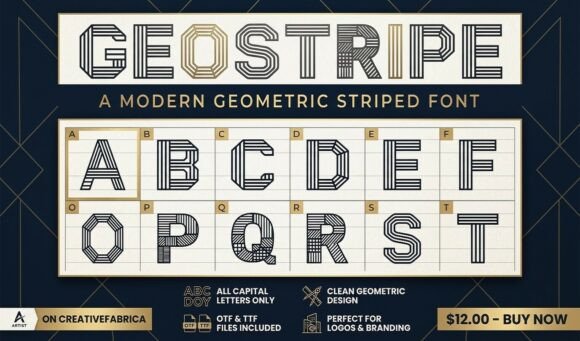
When a design project demands immediate visual authority, standard sans-serif typefaces often fall short of delivering the necessary structural intrigue. Geostripe enters this space not merely as a collection of letterforms, but as a graphic system defined by its unique linear construction. This bold, striking geometric font is engineered through parallel lines that shift direction at sharp angles, generating a fascinating 3D folded ribbon or architectural wireframe effect. For designers and brand strategists aged 20 to 50 who navigate the intersection of digital media and physical print, understanding the practical application of GeoStripe Display is essential for creating work that commands attention without sacrificing legibility.
The Architecture of Attention in Brand Identity
The primary strength of Geostripe lies in its ability to function simultaneously as typography and illustration. In logo design, this duality is invaluable. Traditional logotypes often require a separate icon to establish visual interest, but the intricate wireframe aesthetic of Geostripe allows the wordmark itself to serve as the primary visual anchor. When crafting a monogram for a tech startup or an architecture firm, the intersecting parallel lines suggest precision, engineering, and forward momentum. The font’s inherent depth creates a sense of dimensionality on flat screens, making it particularly effective for app icons and social media avatars where space is limited but impact must be high.
However, the utility extends beyond corporate identity into the realm of personal branding and creative portfolios. For illustrators, 3D artists, and motion designers, using Geostripe in portfolio headers signals a mastery of form and space. It aligns the typographic voice with the visual output of spatial designers, creating a cohesive narrative before the viewer even engages with the work samples. The font acts as a filter, attracting clients who appreciate technical complexity and modernist aesthetics while repelling those seeking traditional or ornate styles.
Retro-Futurism and Editorial Layouts
One of the most dynamic real-world scenarios for Geostripe is within retro-futuristic poster design and editorial spreads. We are currently seeing a resurgence of Y2K and brutalist aesthetics, yet many designs suffer from looking derivative. Geostripe bridges the gap between nostalgic computer graphics and contemporary vector precision. Unlike pixelated retro fonts that mimic low-resolution limitations, Geostripe offers crisp, scalable vectors that honor the optimism of early digital art while meeting modern production standards.
In poster design, the font’s dense linear texture interacts beautifully with negative space. Because the letters are constructed from open parallel lines rather than solid fills, they allow background imagery, gradients, or textures to breathe through the typography. This transparency is a functional asset in layered compositions. A concert promoter designing for an electronic music festival can overlay Geostripe headlines across complex photographic collages without completely obscuring the underlying art. The result is a harmonious integration where text and image coexist rather than compete, solving a common hierarchy problem in busy event marketing materials.
Streetwear, Sports, and Merchandise Application
The transition from screen to fabric presents unique challenges, and this is where Geostripe demonstrates surprising versatility. In streetwear apparel and sports branding, typography must remain readable at a distance and durable through various printing processes. The bold weight of GeoStripe Display ensures that the intricate line work does not disappear when scaled down for chest prints or sleeve details. The angular, folded-ribbon effect translates exceptionally well to embroidery, where the directional changes in the stitch path can physically mimic the font’s digital geometry.
For merchandise designers, consider how this typeface performs across different mediums. On a cotton t-shirt, the linear construction creates a breathable, lightweight visual texture that feels less heavy than a solid block letter. Conversely, on reflective safety gear or athletic jerseys, the sharp angles and high contrast enhance visibility and convey a sense of speed and dynamism. Teams and esports organizations benefit from this aggressive yet calculated aesthetic; it communicates competitiveness without resorting to cliché "athletic" slab serifs. The font suggests a team or brand that is analytical, strategic, and modern.
Navigating Legibility and Hierarchy
While Geostripe is a powerhouse for display purposes, practical application requires disciplined restraint. The very features that make it striking—dense parallel lines and sharp angular shifts—also dictate its limitations. It is fundamentally a headline typeface. Attempting to use it for body copy, captions, or small-scale UI elements will result in visual vibration and poor readability. The optical illusion created by the parallel lines breaks down below certain sizes, turning distinct letterforms into indistinguishable noise.
Successful implementation relies on pairing. Geostripe demands a supportive cast of neutral, highly legible typefaces. A clean geometric sans-serif like Inter or Helvetica Now works best to ground the composition, providing necessary breathing room for the display font to perform. When setting headlines, generous tracking (letter-spacing) is often required. Because the characters are visually dense, tightening the spacing can cause the linear patterns to merge, destroying the 3D effect. Conversely, opening up the tracking enhances the architectural quality, allowing each letter to stand as a distinct structural element.
Technical Considerations for Print and Digital
Before committing Geostripe to a production workflow, specific technical considerations must be addressed to preserve the integrity of the design. In print environments, the thickness of the parallel lines must be evaluated against the chosen substrate and printing method. Offset printing generally handles fine lines better than risograph or screen printing, where ink spread can fill in the negative spaces between the stripes. If producing risograph zines or screen-printed posters, it may be necessary to slightly increase the stroke width or scale up the point size to compensate for ink gain. Always request a physical proof when working with linear typefaces at smaller display sizes to ensure the ribbon effect remains distinct.
In digital contexts, hinting and rendering become critical. On low-resolution displays, the precise parallel lines may alias or shimmer during animation. For web projects, using SVG format rather than WOFF2 for large Geostripe headlines ensures that the vector paths remain crisp regardless of zoom level or screen density. Motion designers should also be mindful of moiré patterns when animating the font over video backgrounds or other textured layers. The regular frequency of the parallel lines can interfere with sensor grids or compression artifacts, so testing across multiple devices is a non-negotiable step in the quality assurance process.
Strategic Selection for Maximum Impact
Choosing Geostripe is ultimately a strategic decision about tone and audience expectation. It speaks fluently to demographics that value innovation, technical skill, and bold aesthetics. It is less suitable for brands requiring warmth, tradition, or organic softness. A bakery, a wellness spa, or a legal firm focused on family law would likely find the font’s rigid geometry emotionally disconnected from their service offering. However, for industries rooted in technology, performance, urban culture, and avant-garde art, Geostripe provides a shorthand for sophistication.
The font also serves as an excellent tool for refreshing established brands without undergoing a full rebrand. Replacing a tired headline font with Geostripe in campaign-specific materials can inject temporary energy and novelty while maintaining core brand equity elsewhere. This modular approach to typography allows marketers to test audience response to bolder aesthetics before making permanent changes. Whether used for a limited-edition product drop, a seasonal campaign, or a permanent identity overhaul, Geostripe offers a distinct visual vocabulary that transforms ordinary text into an immersive graphical experience. By respecting its constraints and leveraging its architectural strengths, designers can create work that is not only seen but felt, establishing a memorable presence in an increasingly saturated visual landscape.