Clair: Redefining Modern Minimalism with Geometric Precision
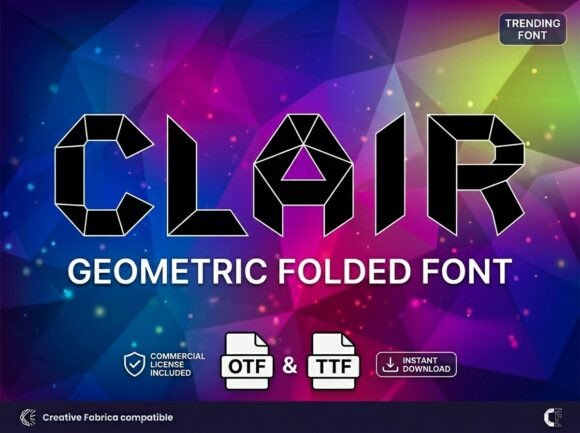
In the crowded landscape of contemporary typography, finding a typeface that balances artistic expression with structural integrity is a rare achievement. Clair emerges as a distinct solution for designers who need their text to do more than just communicate information; it needs to embody an aesthetic philosophy. This trending geometric folded font redefines modern minimalism by treating every character not as a flat glyph, but as an architectural construct. Constructed from precise, triangular facets, Clair creates a striking 3D origami effect that catches light and shadow even in digital environments. For creative professionals aged 20 to 50 navigating the demands of tech branding, editorial design, and immersive media, understanding how to leverage this unique visual weight is essential for creating work that feels both calculated and deeply artistic.
The Architecture of Letterforms in Tech Branding
For digital startups and software companies, the challenge often lies in conveying innovation without resorting to clichéd futuristic tropes. Clair offers a sophisticated alternative to standard sans-serifs by embedding the concept of "structure" directly into the brand identity. When a fintech app or a cybersecurity firm uses Clair for its wordmark, the sharp, mathematical angles suggest precision engineering and algorithmic reliability. The font does not merely say the company name; it visually demonstrates the company’s commitment to exactitude.
Consider a landing page for a new AI development tool. Using Clair for the primary headline transforms the text into a graphical element that mirrors the complexity of the technology itself. The faceted surfaces imply depth and multi-dimensionality, subtly reinforcing the idea that the product has layers of capability. However, practical application requires restraint. Because the font carries significant visual density, it works best when paired with ample negative space. In a tech context, allowing the letters to breathe prevents the interface from feeling cluttered, ensuring that the structured innovation of the typeface enhances rather than overwhelms the user experience.
Editorial Layouts and Avant-Garde Storytelling
Magazine art directors and editorial designers face the constant pressure of stopping the scroll or turning the page. Clair serves as a powerful anchor in avant-garde layouts where traditional hierarchy rules can be bent. Its bold visual weight makes it ideal for pull quotes, chapter openers, and cover lines that demand immediate attention. Unlike decorative scripts that sacrifice legibility for style, Clair maintains a rigid geometric skeleton that keeps the text grounded even at large display sizes.
In fashion and culture publications, this typeface bridges the gap between high art and commercial communication. A feature article on sustainable architecture or brutalist interior design becomes visually cohesive when the typography echoes the subject matter. The origami-like folds resonate with readers interested in craftsmanship and materiality. Designers have observed that using Clair in muted, monochromatic color palettes allows the form of the letters to take center stage, while introducing vibrant gradients across the facets can create a dynamic, almost holographic effect suitable for youth-oriented culture zines. The key here is intentionality; the font should feel like a deliberate curatorial choice that elevates the narrative voice of the piece.
Immersive Identities for Gaming and Cinema
The entertainment industry, particularly within sci-fi gaming and high-concept cinema, thrives on world-building. Clair provides a ready-made visual language for futuristic environments. Game developers and motion graphics artists appreciate the font’s inherent sense of movement and tension. The sharp angles suggest speed, conflict, and advanced technology, making it an exceptional choice for game logos, HUD (heads-up display) elements, and title sequences.
When designing a poster for a dystopian thriller or a cyberpunk RPG, Clair eliminates the need for excessive post-processing effects to make the text look "designed." The 3D structure is baked into the vector data, meaning it scales perfectly from a mobile banner to a billboard. Practical experience suggests that animators find Clair particularly rewarding to work with in motion; the distinct planes of each letter allow for complex lighting rigs and camera moves that reveal different aspects of the typeface as it rotates. This interactivity turns static branding into a living part of the story world, deepening audience immersion before the content even begins.
Navigating Legibility and Hierarchy
While Clair is undeniably striking, its distinctive geometry introduces specific functional considerations that designers must navigate. The very features that make it beautiful—the folds, the angles, the density—also dictate its limitations. It is fundamentally a display typeface. Attempting to use Clair for body copy, captions, or small UI labels will inevitably lead to readability issues. The intricate details that shine at 72pt become muddy noise at 12pt. Successful projects using Clair always employ a robust supporting cast of highly legible neutral sans-serifs or monospaced fonts to handle the heavy lifting of information delivery.
Contrast management is another critical factor. Because the characters rely on simulated light and shadow to define their shapes, placing Clair on a busy photographic background can cause the letters to disappear. Designers frequently solve this by using solid color blocks behind the text or by applying subtle drop shadows that complement the font’s internal shading. Additionally, tracking (letter-spacing) requires careful adjustment. The angular nature of the glyphs means that default spacing can sometimes create awkward visual gaps or collisions. Tightening the tracking slightly often helps lock the geometric forms together into a cohesive unit, enhancing the architectural feel.
Strategic Pairing and Visual Balance
To maximize the impact of Clair, one must think about what surrounds it. The font possesses a strong personality that can easily dominate a composition. Effective visual storytelling involves creating a dialogue between Clair and other design elements rather than letting it shout alone. Pairing it with organic photography creates a compelling tension between the natural and the constructed. Conversely, combining it with clean line art or wireframe graphics reinforces a technical, blueprint-inspired aesthetic.
Color selection also plays a pivotal role in how the folded geometry is perceived. Flat colors emphasize the silhouette and graphic quality of the letters, making them feel more like logos or symbols. Metallic textures and gradients, however, activate the 3D illusion, highlighting the peaks and valleys of the origami folds. For boutique architectural firms or luxury real estate brands, a matte charcoal or brushed gold treatment conveys premium stability. For esports teams or music festivals, neon accents against dark backgrounds amplify the energetic, futuristic vibe. Understanding these nuances allows designers to adapt Clair to vastly different emotional contexts while maintaining its core identity of structured innovation.
Making the Right Choice for Your Project
Deciding whether Clair is the right tool for a specific project ultimately comes down to the message you intend to convey. If the goal is warmth, tradition, or approachability, this geometric powerhouse may send mixed signals. However, if the objective is to project competence, forward-thinking design, and meticulous attention to detail, few typefaces deliver this combination as effectively. It appeals to an audience that values intelligence in aesthetics, recognizing that true minimalism is not about removing elements, but about refining them to their most essential, potent form.
Designers should view Clair not just as a font file to be installed, but as a modular building block for visual identity. Whether you are crafting a pitch deck for a venture capital meeting, designing album art for an electronic musician, or overhauling the signage system for a modern museum, Clair offers a vocabulary of precision. By respecting its constraints and leveraging its strengths, you ensure that your typography does more than fill space—it actively participates in the storytelling, adding a layer of intellectual and visual rigor that resonates with discerning modern audiences.