Marker Pen Mischief: Bold Display Font Guide
In a digital landscape often dominated by sterile grids and pixel-perfect geometry, there is a growing hunger for typography that feels human, tactile, and intentionally imperfect. Marker Pen Mischief answers this call as a high-energy display font that captures the spontaneous spirit of hand-drawn art. This typeface is not designed to disappear into the background; it demands attention with chunky, puffy characters filled with solid black ink and encased in a unique, vibrating wavy outline. The irregular wiggle of the border imbues every word with a sense of kinetic movement and playful mischief, distinguishing it sharply from standard block fonts.
For designers and creators navigating the current resurgence of retro-pop and Y2K aesthetics, this font offers an immediate shortcut to an approachable, artisanal look. However, its utility extends far beyond nostalgia. Understanding how to leverage its specific characteristics requires looking at the font through different lenses, depending on your role, skill level, and project goals. Whether you are a seasoned brand strategist or a hobbyist making stickers for friends, evaluating Marker Pen Mischief involves balancing its expressive visual impact against practical application needs.
The Visual Language of Imperfection
At its core, Marker Pen Mischief is a study in controlled chaos. The thick silhouettes provide the necessary weight for headlines and large-format printing, ensuring readability even at a distance. Yet, it is the hand-drawn lines and the oscillating outer stroke that add a personal, custom-made touch. This duality makes it particularly effective for projects that need to feel bespoke rather than mass-produced.
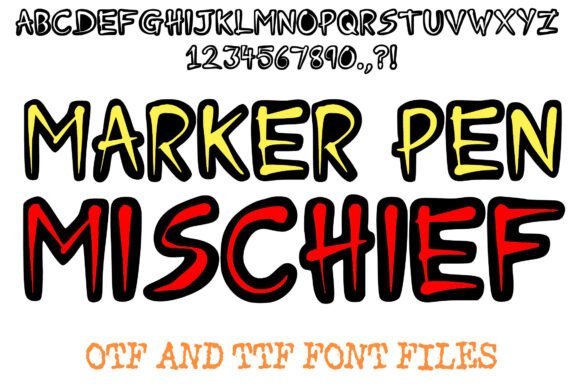
It is crucial to note the technical scope before integrating this typeface into a workflow. The font contains OTF and TTF files, ensuring compatibility across most design software and operating systems. However, users must be aware that only capital letters, numbers, and select punctuation marks (period and comma) are included. This limitation is not a flaw but a deliberate design choice that reinforces its identity as a display tool. It forces the user to treat text as graphic elements rather than body copy, encouraging more intentional layout decisions.
Perspectives for Creative Professionals and Marketers
For marketing professionals and brand designers, the primary evaluation criteria for any asset are typically versatility and commercial viability. Marker Pen Mischief excels in campaigns targeting Gen Z and Millennial demographics who associate polished perfection with corporate inauthenticity. In this context, the font’s "wobbly" aesthetic signals relatability and fun.
- Digital Branding: Use the font for social media story overlays, YouTube thumbnails, or website hero banners where quick visual engagement is paramount. The vibrating outline performs exceptionally well on screens, creating a subtle optical vibration that arrests the scroll.
- Packaging Design: For artisanal food brands, craft beverages, or indie beauty products, this typeface mimics the look of hand-labeled goods without the inconsistency of actual handwriting. It bridges the gap between scalable production and boutique charm.
- Merchandise: The bold fill and distinct outline make it ideal for apparel and tote bags. Because the characters are solid black with a defined edge, they reproduce cleanly on various textile printing methods, from screen printing to direct-to-garment.
Professionals should view this font as a specialized accent tool. Its value lies in its ability to create hierarchy. When paired with a clean sans-serif for body text, Marker Pen Mischief establishes a focal point that guides the viewer’s eye while setting an emotional tone. The priority here is presentation and trend relevance, making it a strategic asset for time-sensitive campaigns.
Educators, Hobbyists, and the Joy of Creation
While professionals assess fonts based on ROI and brand alignment, educators, students, and hobbyists often prioritize ease of use, learning value, and pure creative expression. For these groups, Marker Pen Mischief serves as an accessible entry point into typographic experimentation.
Educators and Workshop Leaders may find this font invaluable for teaching design principles related to texture and mood. Because the all-caps constraint removes the complexity of kerning lowercase pairs, beginners can focus entirely on spacing, scale, and color interaction. It is an excellent resource for creating engaging classroom materials, event flyers, or club signage that feels energetic and welcoming rather than institutional.
Hobbyists and DIY Creators often seek assets that elevate personal projects without requiring advanced technical skills. Whether designing bullet journal headers, custom greeting cards, or planner stickers, the font provides instant gratification. The "puffy" nature of the letters makes them satisfying to color digitally or trace physically. For this audience, the cost-benefit analysis is less about commercial return and more about the joy of making something that looks professionally crafted with minimal effort. The inclusion of both OTF and TTF formats ensures that whether one is using Adobe Illustrator, Procreate, Canva, or Cricut Design Space, the file will likely work seamlessly.
Evaluating Fit: Is This Font Right for Your Project?
Deciding whether to incorporate Marker Pen Mischief into your toolkit depends on aligning its inherent traits with your specific objectives. Not every project benefits from high-energy imperfection. Consider the following factors to determine if this typeface matches your current needs.
- Tone Alignment: Does your message benefit from playfulness and informality? If you are designing for legal documents, luxury watchmaking, or medical instructions, the vibrating outline may undermine the necessary authority and precision. Conversely, for festivals, casual dining, creative portfolios, or youth-oriented content, it amplifies the intended message.
- Readability Requirements: Remember that this is strictly a display font. If you need to convey dense information or long paragraphs, this is not the solution. Reserve it for titles, short phrases, logos, and callouts. If your project relies heavily on body text, ensure you have a complementary typeface ready.
- Technical Constraints: Verify that the all-caps limitation works for your acronym-heavy or headline-focused content. If you require sentence case or extensive punctuation, you will need to look elsewhere. However, if you embrace the uppercase aesthetic, this constraint becomes a stylistic unifier.
- Longevity vs. Trend: While Y2K and retro-pop are currently dominant, consider the lifespan of your project. For ephemeral content like Instagram stories or seasonal sales, leaning into the trend is advantageous. For evergreen branding, use the font sparingly as an accent to avoid dating the design too quickly.
Practical Application Tips for Maximum Impact
To get the most out of Marker Pen Mischief, users should adapt their workflow to complement its organic structure. Because the outline is intentionally irregular, avoid forcing the text into rigid alignment boxes. Let the natural wiggle dictate the rhythm of the layout. Overlapping letters slightly can enhance the hand-drawn illusion, making the composition feel even more dynamic.
Color selection also plays a pivotal role. While the default solid black fill is iconic, many design programs allow you to change the fill color independently of the outline. A white fill with a black outline creates a sticker-like effect that pops against dark backgrounds. Alternatively, using a vibrant neon fill with the black border leans harder into the retro-pop aesthetic. For those working in physical media, printing the font on textured paper stock can further emphasize its marker-pen origins, bridging the digital-physical divide.
Ultimately, Marker Pen Mischief is more than just a collection of vector shapes; it is a permission slip to embrace the beauty of imperfection. Whether you are a business owner seeking to humanize your brand, an educator fostering creativity, or a designer exploring the boundaries of retro-modernism, this typeface offers a distinct voice. By understanding its specific strengths and limitations, you can harness its chaotic energy to create work that feels genuinely alive, proving that sometimes the most professional choice is to let things get a little messy.