Evaluating Bloomsy Font for Creative Design Projects
Selecting the appropriate typeface is a foundational decision in visual communication, as typography carries significant weight in establishing tone and brand identity. Bloomsy is a retro display font characterized by bold, rounded shapes and a handcrafted aesthetic. Unlike neutral sans-serif or traditional serif typefaces designed for utility, Bloomsy serves a specific expressive purpose. For designers, marketers, and business owners evaluating this font, understanding its functional applications, technical specifications, and inherent limitations is essential for determining whether it aligns with current project requirements. This assessment explores where Bloomsy fits within the broader typographic landscape and provides practical insights for informed selection.
Defining the Visual Character of Bloomsy
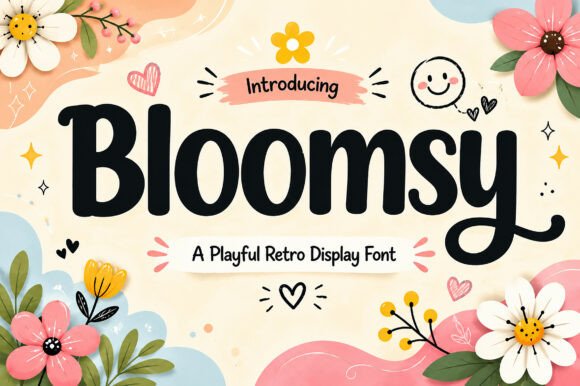
Bloomsy falls into the category of playful retro display typography. Its primary visual markers include chunky letterforms, smooth curves, and an organic, hand-drawn quality that deviates from rigid geometric precision. The design intent is to evoke warmth, charm, and approachability. When evaluating this font, it is important to recognize that these characteristics are not merely decorative; they communicate specific psychological cues to the viewer. Rounded typefaces are frequently associated with friendliness, safety, and youthfulness, while the retro influence suggests nostalgia and authenticity.
The font includes a comprehensive character set comprising uppercase letters, lowercase letters, numbers, and punctuation. Additionally, it offers multilingual support and PUA encoding, which allows access to special characters and alternates without requiring specialized design software. These technical features ensure that the font remains functional across various platforms and languages, reducing friction during the implementation phase. However, the distinct personality of the letterforms means that Bloomsy is inherently stylized, positioning it firmly as a display face rather than a versatile workhorse typeface.
Ideal Applications and Strategic Fit
Bloomsy performs best in contexts where the primary goal is to capture attention and convey a positive, informal emotional response. Based on its design attributes, it is particularly well-suited for specific commercial and creative applications:
- Children’s Products and Education: The soft, rounded terminals and chunky proportions align with safety standards and aesthetic expectations in the juvenile market. It works effectively on toy packaging, educational materials, and children's apparel.
- Artisanal and Handmade Branding: Brands emphasizing craft, homemade quality, or personal touch benefit from the font’s irregular, handcrafted feel. It supports narratives of authenticity in labels, stickers, and shop signage.
- Social Media and Digital Content: In crowded digital feeds, high-contrast, bold display fonts improve scroll-stopping potential. Bloomsy’s unique silhouette aids in creating recognizable templates for Instagram stories, Pinterest pins, and YouTube thumbnails.
- Event Stationery: For birthday invitations, baby showers, and casual celebrations, the font provides a festive yet legible alternative to formal scripts or standard block letters.
- Merchandise and Apparel: The bold weight ensures readability when printed on textiles or applied as vinyl decals, making it a practical choice for t-shirt designs and tote bags.
In these scenarios, Bloomsy acts as a primary visual anchor. Its strength lies in short-form text such as headlines, logos, and product names where immediate impact outweighs the need for sustained reading comfort.
Tradeoffs and Practical Considerations
While Bloomsy offers distinct advantages for targeted projects, objective evaluation requires acknowledging its limitations. Understanding these tradeoffs prevents misuse and ensures professional results.
Legibility at Small Sizes
Due to its bold weight and rounded details, Bloomsy may lose clarity when scaled down significantly. Intricate curves can fill in at small point sizes, particularly in low-resolution print or screen environments. Designers should test the font at the smallest intended size before finalizing layouts. If body copy or fine print is required, pairing Bloomsy with a clean, neutral sans-serif is necessary to maintain hierarchy and readability.
Tone Specificity
The playful and retro nature of Bloomsy makes it unsuitable for industries requiring gravitas, formality, or corporate neutrality. Financial institutions, legal services, luxury fashion, and medical technology typically require typography that conveys stability and precision. Using Bloomsy in these contexts could create cognitive dissonance, undermining trust or perceived professionalism. Evaluators must ensure the font’s cheerful personality matches the brand voice; if the brand is serious, minimalist, or avant-garde, this typeface will likely clash.
Visual Weight and Spacing
Chunky display fonts occupy significant horizontal and vertical space. In layouts with limited real estate, such as mobile app interfaces or dense packaging labels, Bloomsy may dominate the composition excessively. Careful attention to kerning and line height is required to prevent the text from feeling cramped or overwhelming adjacent design elements. Unlike modular system fonts, decorative typefaces often require manual optical adjustments to achieve balanced spacing.
Comparing Alternatives
When deciding whether to adopt Bloomsy, it is helpful to compare it against other typographic categories to validate the choice:
- Versus Geometric Sans-Serifs: Fonts like Futura or Montserrat offer roundness but with mathematical precision. Choose geometric sans-serifs if you need a modern, scalable look that retains some softness without the overt retro nostalgia of Bloomsy.
- Versus Handwritten Scripts: Script fonts convey personalization but often sacrifice legibility. Bloomsy offers a middle ground: the warmth of handwriting with the readability of block letters. Select Bloomsy if clarity is as important as charm.
- Versus Vintage Revivals: Some retro fonts feature distressed textures or sharp serifs. Bloomsy is cleaner and more contemporary in its execution. Opt for textured revivals if historical accuracy is the goal; choose Bloomsy for a fresh, updated take on vintage aesthetics.
This comparative analysis helps clarify whether Bloomsy’s specific blend of playfulness and structure is the optimal solution or if another category better serves the project’s functional needs.
Technical Implementation and Licensing
From a workflow perspective, Bloomsy’s PUA encoding facilitates easy access to glyphs in standard design software, streamlining the customization process. Multilingual support expands its utility for international campaigns or bilingual packaging, reducing the need to source supplementary typefaces. However, users must verify licensing terms relative to their intended use. Display fonts often have different licensing tiers for personal versus commercial application, especially for merchandise or large-scale branding. Confirming that the license covers all planned deliverables is a critical step in the evaluation process to avoid future compliance issues.
Making the Final Decision
Bloomsy represents a specialized tool in the typographic arsenal. It excels when the objective is to inject personality, warmth, and retro charm into visual identities, packaging, and promotional materials. Its success depends entirely on alignment between the font’s expressive qualities and the project’s communicative goals. For brands targeting families, creatives, or lifestyle audiences seeking approachability, Bloomsy offers a distinctive and technically competent option. Conversely, for projects demanding neutrality, high-density information, or formal authority, alternative typefaces will yield superior outcomes.
Ultimately, the decision to use Bloomsy should be driven by audience expectations and functional requirements rather than aesthetic preference alone. By testing the font in context, considering pairing strategies, and respecting its limitations regarding scale and tone, designers can leverage Bloomsy effectively to create memorable, emotionally resonant work. When the fit is right, it transforms generic layouts into distinctive brand assets; when the fit is wrong, no amount of styling can compensate for the fundamental mismatch. Objective evaluation ensures that typography serves the design, not the other way around.